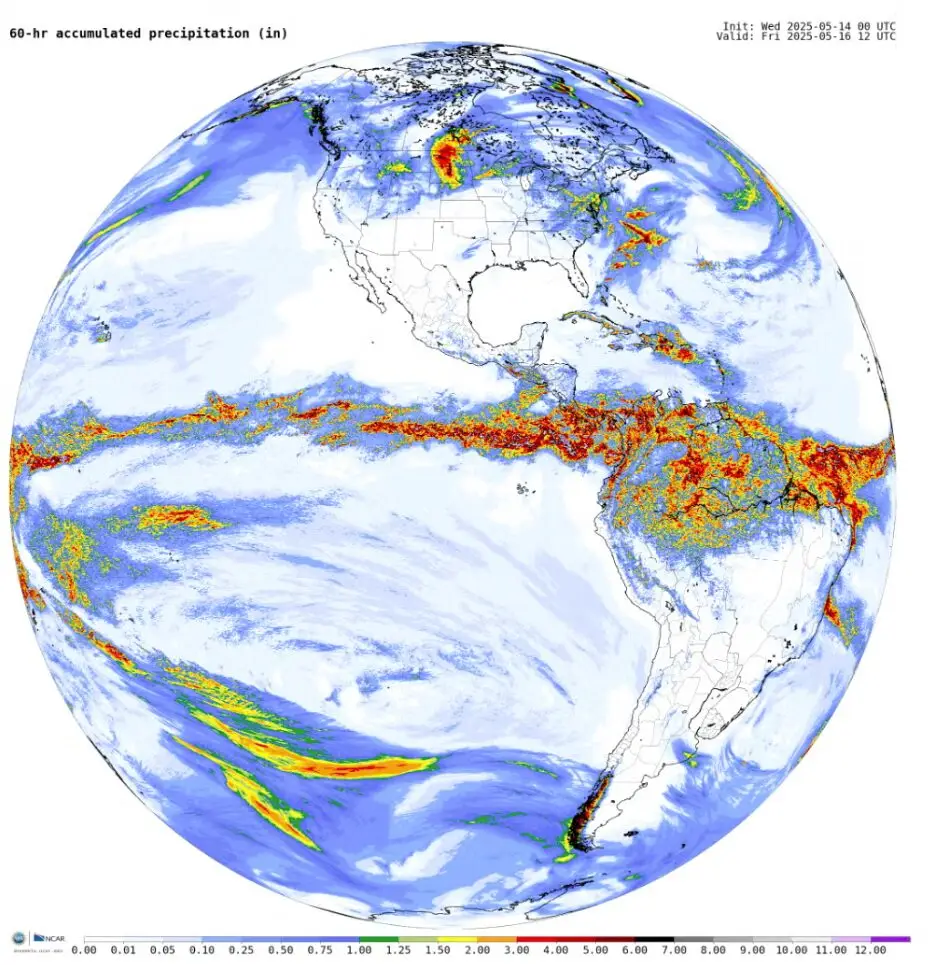
Scientists at the U.S. National Science Foundation National Center for Atmospheric Research (NSF NCAR) have begun running real-time 3km (1.9-mile) experimental weather forecasts for the entire globe. The real-time forecasts are more fine-scale than other real-time global weather models, providing detail down to individual thunderstorms.
Global weather models use a grid system to represent the atmosphere, applying physics to simulate temperature, humidity, and other metrics at specific points. When grid points are closer together, it allows for more accurate and detailed forecasts. Many global models use 12km grid cells, but NSF NCAR’s experimental model uses 3km grid cells. The model is at such a fine-scale that it consists of about 65.5 million horizontal grid cells over the entire Earth’s surface. Each cell has a vertical component as well that includes 55 layers up into the atmosphere.
As of now, the research team produces a single forecast each day out to 60 hours. The forecasts will be evaluated for accuracy to see how they performed compared to other forecast models. The team is also running a real-time 8-member ensemble of 3km forecasts over North America, going out to 132 hours.
Ultimately, a real-time weather model with this amount of detail worldwide could lead to significant advances in worldwide weather prediction, especially in remote regions of the world and where communities are most at risk of extreme weather.