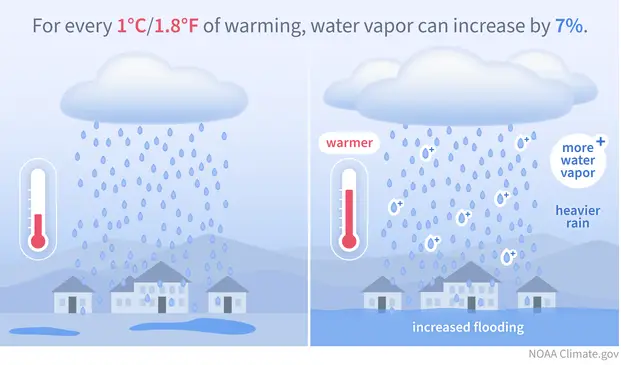
According to the Fifth National Climate Assessment, heavy precipitation in the contiguous United States has increased since the 1950s. Between 1958-2021, the southeast has seen a 37% increase in total precipitation and the northeast has seen a 60% rise. Global warming has also increased the frequency, severity, and amount of extreme precipitation.
Oftentimes, extreme precipitation events can form within a matter of hours, driven by complex moisture, temperature, and wind patterns. NOAA’s Climate Program Office has invested in top researchers to advance climate science and services to try and predict major precipitation eventsweeks, months, and even years in advance. If successful, it could save lives, livelihoods, property, and critical infrastructure.
The Climate Program Office, along with other national and international partners, is studying key patterns and processes in the formation of extreme rainstorms to build more accurate computer weather models and long-term forecasts. With the help of machine learning, their research has shown that there are large-scale circulation patterns associated with winter and summer rainfall extremes, and important North Atlantic sea surface temperature anomalies associated with the Gulf Stream that are a potential source of predictability.
The next step of their research includes the Tropical Pacific Observing System Equatorial Pacific Experiment (TEPEX), a field campaign from 2026-2028 designed to investigate how ocean-atmosphere interactions affect weather patterns around the world, including extreme precipitation in the United States.