July 2025 was one for the record books. Eighteen states in the central and eastern United States and Washington D.C. just experienced their most humid July since records began in 1981.An additional eight states experienced their second or third muggiest July on record. For the country as a whole, the United States just saw its third-highest humidity levels on record.
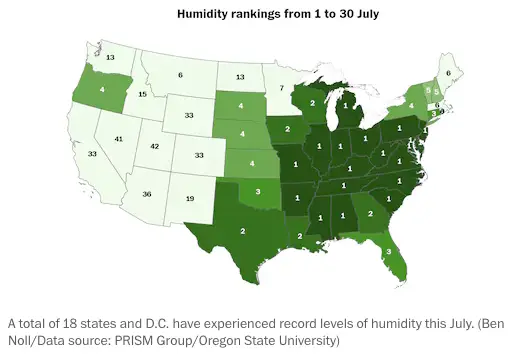
Although humid weather in July is not unusual, it is unusual to have humidity that is relentlessly well above average. Heat indices in Florida reached around 120F and Missouri’s head index climbed to 128F!
July temperatures were also above average for the majority of the continental United States, amplifying the effects of the high humidity. The excessive atmospheric moisture exacerbated corn sweat and contributed to multiple deadly floods. Only six states experienced below-average humidity in July.
So what is contributing to the higher humidity?
The Bermuda-Azores high-pressure system, a semipermanent dome of fair summer weather that typically sits over the central Atlantic, has been further west than normal this summer, bringing hot and humid southerly winds to the central and eastern states. Ocean temperatures across the Atlantic have also been above average, adding more moisture and heat to the equation.
As the Earth trends more humid and warmer due to climate change, the average dew point is expected to continue to rise as it has over the past few decades.
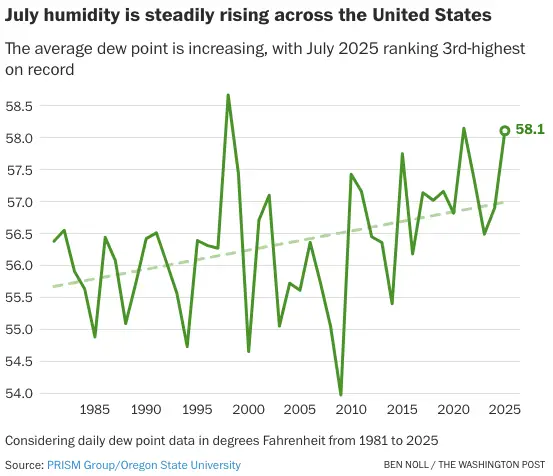
Keep in mind that there are multiple ways to describe how muggy” the air feels. When we talk about humidity, that refers to the ratio of the amount of water vapor in the air compared to the amount of moisture the air could hold, and it is usually expressed as a percentage. When we talk about dew point, we are talking about the temperature at which water will condense in the air, and it is displayed as a temperature.
It is argued that the dew point is a better indicator of how humid it feels outside than relative humidity.The higher the dew point rises, the greater the amount of moisture is in the air.
For example, a temperature of 30F and a dew point of 30F will give you a relative humidity of 100%, but a temperature of 80F and a dew point of 60 produces a relative humidity of 50%. It would feel much more humid on the 80F day with 50% RH compared to the 30F day with a 100% RH. This is because of the higher dew point.
In general, a dew point less than or equal to 55F in the summer is considered dry and comfortable. A dew point between 55F and 65F will feel sticky” with muggy evenings. A dew point greater than or equal to 65F will have a lot of moisture in the air and become oppressive.