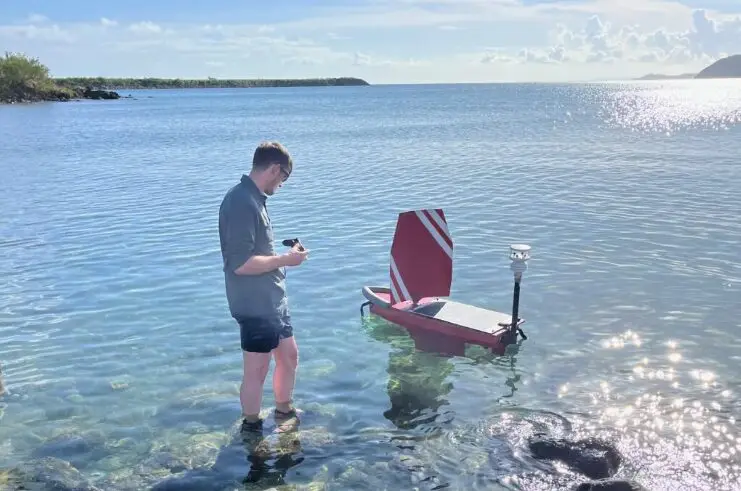
The National Oceanic and Atmospheric Administration (NOAA) has partnered with The University of Southern Mississippi and the robotics company Oshen to collect critical data and improve hurricane forecasting and research. On August 31st, NOAA launched five small uncrewed surface vehicles (USVs) called C-Stars off the coast of the U.S. Virgin Islands. Two additional C-Stars are ready for launch ahead of actively developing tropical systems this fall.
C-Stars transmit real-time data on wind speed and direction, sea surface temperature, air temperature, air pressure, and relative humidity via satellite for forecasters and scientists. Once the C-Stars are recovered, they will also have wave condition data, high-resolution images, and high-resolution video.
These four foot long, sailboat-looking USVs will be remotely piloted by specialists in the United Kingdom and will operate experimentally over the next two months. Previously, the C-Stars have been used in the U.S. and Europe to collect ocean weather and climate data, as well as monitor marine mammals. They’ve been able to navigate 24-foot waves, but hurricanes will be a greater challenge.
If all goes according to plan, these USVs could improve observations and understanding of hurricanes while keeping costs lower and reducing safety risks.