On December 17, the National Oceanic and Atmospheric Administration (NOAA) launched a groundbreaking new suite of operational, artificial intelligence (AI)-driven global weather prediction models. This effort marks a significant advancement in forecast speed, efficiency, and accuracy, while using a fraction of the computational power.
The new suite of models includes three applications:
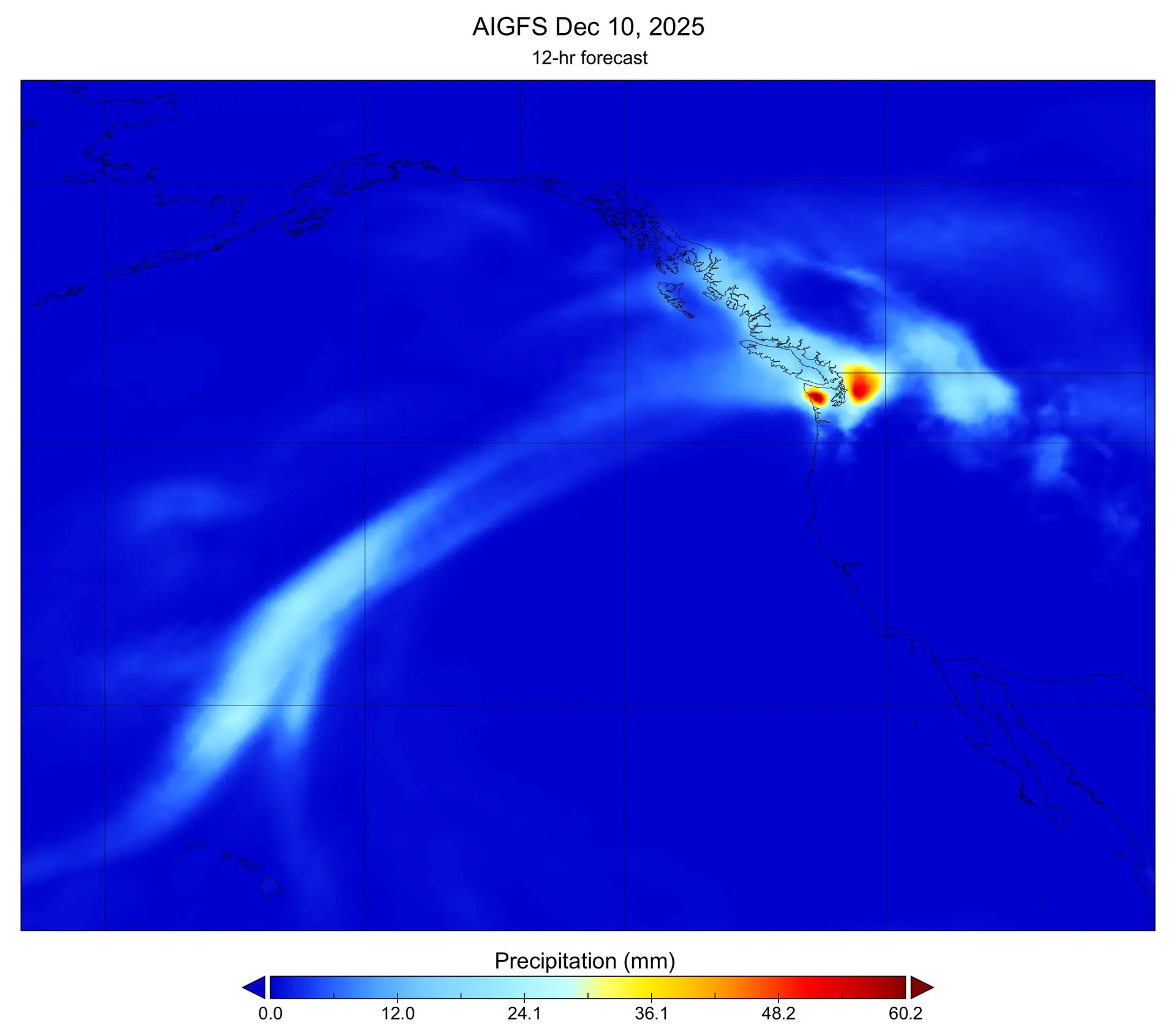
- Artificial Intelligence Global Forecast System (AIGFS): A weather forecast model that implements AI to deliver improved weather forecasts more quickly and efficiently, using up to 99.7% less computing resources than its traditional counterpart. Most notably, it shows a significant reduction in tropical cyclone track errors at longer lead times. It can also produce a single 16 day forecast in just 40 minutes.
- Artificial Intelligence Global Ensemble Forecast System (AIGEFS): An AI-based ensemble system that provides a range of probable forecast outcomes to meteorologists and decision-makers. Early results show improved performance over the traditional GEFS, extending forecast skill by an additional 18 to 24 hours. It includes 31 ensemble members, but requires only 9% of the computing power.
- Hybrid-GEFS (HGEFS): A pioneering, hybrid “grand ensemble” that combines the new AIGEFS with NOAA’s flagship ensemble model, the Global Ensemble Forecast System. Initial testing shows that this model, a first-of-its kind approach for an operational weather center, consistently outperforms both the AI-only and physics-only ensemble systems. It includes 62 ensemble members.
Additionally, NOAA is working on the next generation of convection-allowing, rapidly-updating models. The Rapid Refresh Forecast System (RRFS) is a prototype that is currently scheduled for operational implementation in 2026. Like the current North American Mesoscale Forecast System 3km (NAM 3km), the RRFS will feature a 3 kilometer grid covering North America and include deterministic forecasts every hour out to 18 hours, with deterministic and ensemble forecasts to 60 hours four times per day.
The RRFS will provide guidance to support interests including aviation, severe convective weather, renewable energy, heavy precipitation, and winter weather on timescales where rapidly-updating guidance is useful.