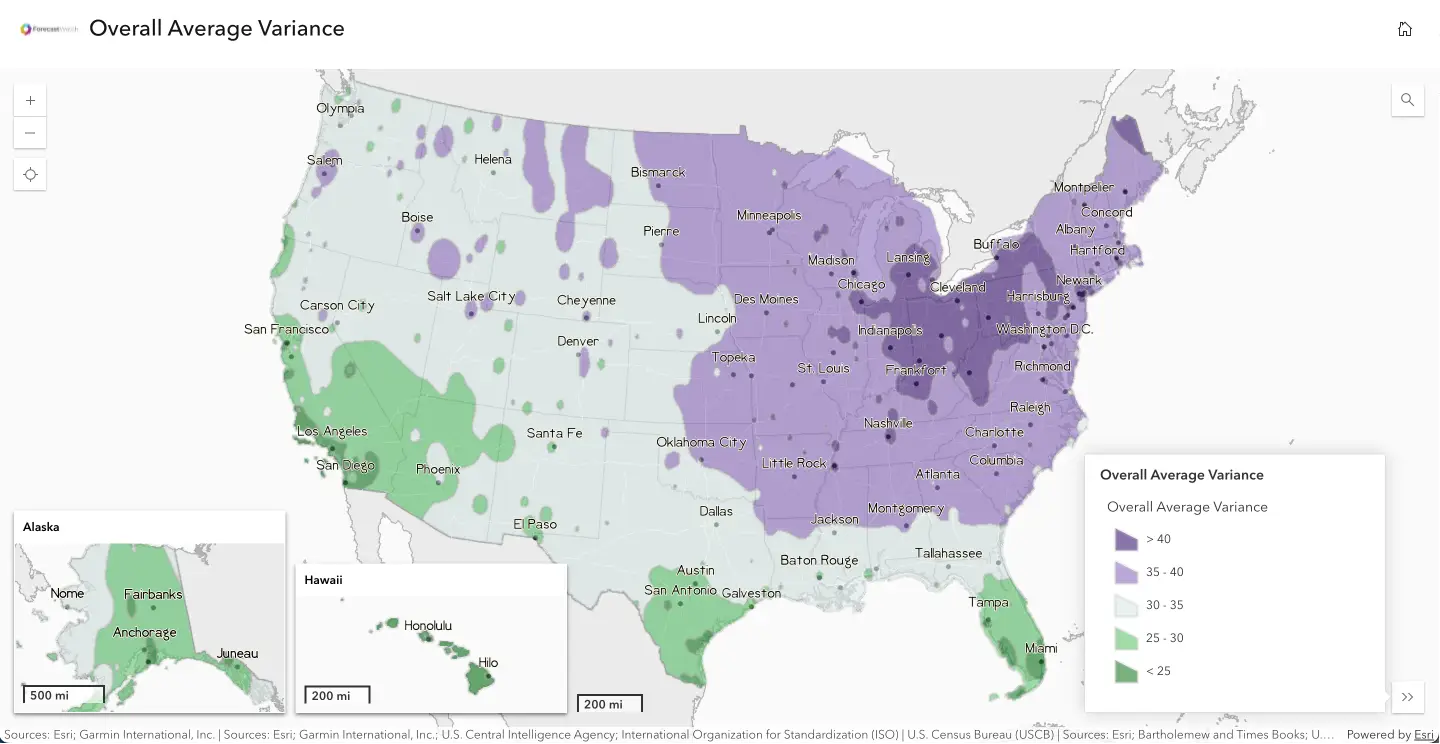
As part of our Best Places to Live or Work in the United States If You Need to Know What the Weather Will Be Like Tomorrow 2025 report, we calculated the overall average variance for each of the 793 locations analyzed to see which areas were easier and harder to forecast weather. Overall average variance was calculated by taking the difference between forecasts and persistence of high temperatures, low temperatures, and precipitation.
The higher the overall average variance is, the harder it is to forecast for that region and a higher level of forecasting skill is needed. Higher variances were generally found in the eastern half of the United States, excluding Florida and southern Texas, and along portions of the Rocky Mountains. These areas are generally further inland and exposed to a variety of frontal boundaries and air masses that can change weather conditions quickly, wetter regions, have mountain/valley influences, and/or where persistence forecasting is less accurate, which makes forecasting difficult and requires more skill in these areas.
Locations with higher variances are where weather forecasts by skillful meteorologists significantly improve upon the accuracy of persistence forecasts most of the time due to much greater daily variability. In these locations, skillful meteorologists can produce even more accurate forecasts using their knowledge and expertise, along with meteorological tools and technology, to generate forecasts that are regularly more accurate than those that would simply be produced using what happened the day before (a persistence forecast) or an average of the last 30 years (a climatological forecast).
The lower the overall average variance is, the easier it is to forecast for that region and where a lower level of forecasting skill is needed. Lower variances were generally found in tropical or near-tropical environments such as Hawaii, Puerto Rico, southern Texas, and southern Florida, as well as locations near large moderating bodies of water such as California and Alaska. Generally, the farther south and/or closer to a large moderating body of water a location is, forecasts and persistence will be more accurate for the coming days.
This would be considered an unskilled forecast as it requires little-to-no knowledge or expertise in the field of meteorology, nor special tools such as access to weather satellites, radars, numerical weather prediction models, and so on, to produce. Therefore, places where there is little weather variability are good candidates for people to go who want to know what the weather will be like tomorrow because a persistence forecast would be consistently accurate. In these locations, the value of meteorologists is quite low most of the time, but meteorologists do still provide needed skills when weather does vary or becomes extreme.
To take a deeper look, download our full report here.