The International Research Institute for Climate and Society (IRI) has routinely disseminated ENSO forecasts each month since 2002. The forecasts include both deterministic and probabilistic forecasts, referred to as the IRI ENSO predictions plume, which provides insights into the expected ENSO conditions over the next nine overlapping 3-month periods.
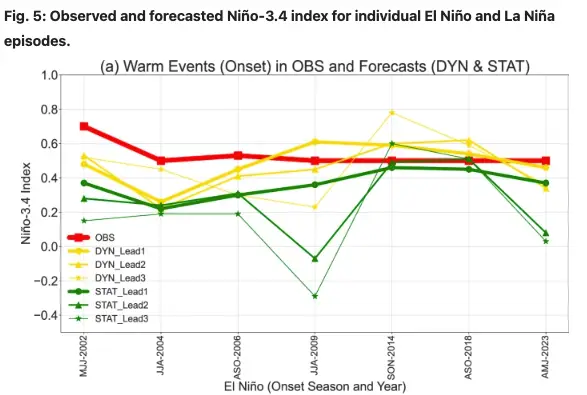
A paper* published in December 2024 evaluated 253 real-time ENSO forecasts issued between February 2002 and February 2023 and examined multimodal means of dynamical (DYN) and statistical (STAT) models.
The study found that over the past two decades, La Nina, the cold phase of ENSO, has become more prevalent, with conditions present about 32% of the time period. The increasing frequency of La Nina was attributed to a persistent negative phase of the Pacific Decadal Oscillation (PDO) since early 2000, anomalous Indo-Pacific Warm Pool warming, and stronger Walker Circulation.
During the evaluated time period, there were seven cold events encompassing 85 3-month seasons and seven warm events encompassing 73 seasons. The skill of the DYN and STAT forecasts demonstrated substantial variation based on the forecast start month and the target season. The DYN forecasts exhibited superior performance when initiated during the boreal spring months, especially from February to May.
The STAT forecasts were comparable to the DYN forecasts in predicting ENSO during the boreal summer and fall. Both the DYN and STAT forecasts tended to have larger errors when predicting the onset of cold ENSO episodes compared to warm episodes.
Overall, DYN forecasts offered valuable insights several months in advance regarding the onset of both warm and cold ENSO episodes, while STAT forecasts provided limited information. It is important to note that DYN forecasts have rapidly evolved over the last two decades, while STAT forecasts have seen limited progress.
Recently, machine learning techniques have been effective in hindcast ENSO forecast settings, extending predictions up to 18 months in advance. Some of the machine learning techniques have now been incorporated into the IRI ENSO plume and could potentially help the models offer better real-time forecasts of ENSO conditions.
*This study was not performed by ForecastWatch.