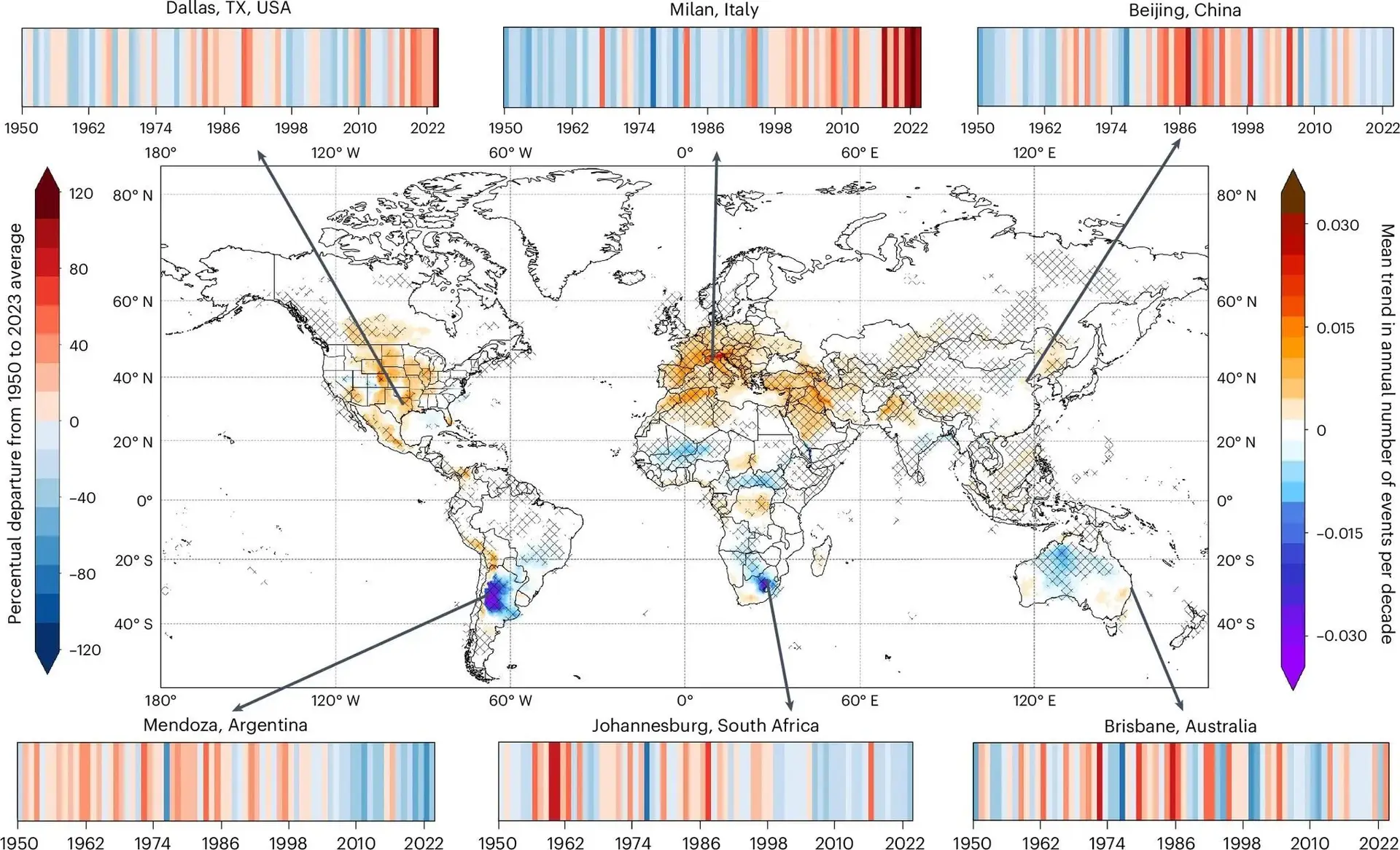
A study led by the European Severe Storms Laboratory and published in Nature Geoscience provides the first comprehensive global analysis of very large hail (>5 cm).Storms producing hail larger than 5cm cause the most severe damage to property and infrastructure, often leading to multi-billion dollar losses.
The study analyzed very large hail events from 1950 to 2023 and found that northern Argentina was the global hotspot for very large hail events, followed by Uruguay, Paraguay, southern Brazil, the U.S. Great Plains, and South Africa. Asia, Europe, and Australia were found to have substantially less frequencies of very large hail events.
Europe has seen the sharpest rise in frequency of very large hail events, driven by increasing low-level moisture and atmospheric instability. On the other hand, the Southern Hemisphere, and especially South America, has experienced notable declines in the frequency of very large hail events, likely linked to reduced mid-level humidity and instability.
Hail-related economic losses have increased in the United States, Australia, and Europe. In Europe, the losses have increased mainly due to the increased frequency of very large hail events. However, economic losses in the United States and Australia are mainly due to increasing exposure and vulnerability.