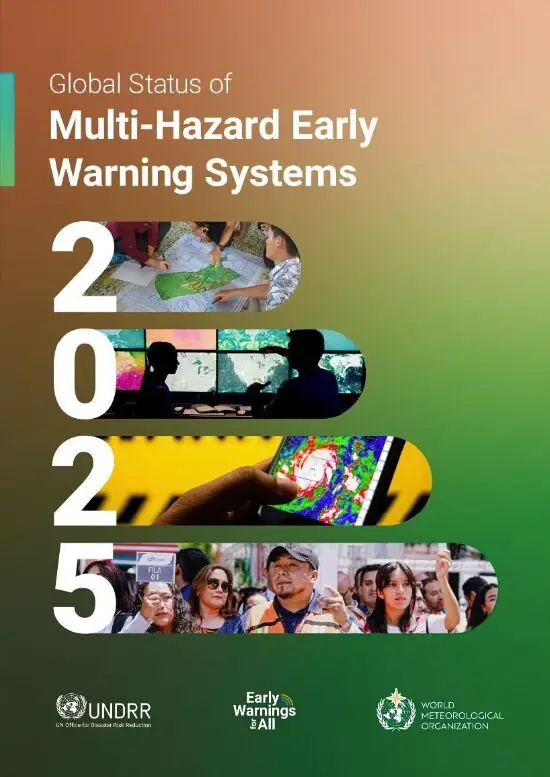
The World Meteorological Organization and the United Nations Office for Disaster Risk Reduction recently released their Global Status of Multi-Hazard Early Warning Systems: 2025 report. The report builds on status reports from previous years by talking about the current status of multi-hazard early warning systems (MHEWS) and the Early Warnings for All (EW4All) initiative that launched in 2022 that seeks to achieve universal coverage of early warnings of weather hazards within five years.
The 2025 report notes progress made, celebrates successes, identifies persistent gaps, and recommends courses of action to be taken to meet the goal of Early Warnings for All. The key findings from the report are as follows:
- Disaster-related mortality has been largely contained over the last decade.
- Climate-related disasters resulted in higher financial losses in 2024 than previous years, with tropical cyclones alone costing the world $135 billion.
- Despite advances in observing and predicting hydrometeorological events, the most devastating disasters in 2024 were weather-related and may have been made more likely due to climate change.
- Disaster-related mortality in countries with more comprehensive MHEWS capabilities is nearly six times lower than in countries with limited capabilities.
- More than 60% of all countries have reported the existence of MHEWS, with a 45% improvement in comprehensiveness scores for MHEWS capabilities across all regions.
- People-centered, locally led approaches to MHEWS work better than outsourcing.
- MHEWS function best when they are embedded within a country’s disaster risk governance framework.
- Collaboration and Coordination are facilitating MHEWS to scale up with an all of society” approach, enabling all stakeholders to contribute.
- More funding is becoming available to invest in MHEWS, but the funding must be targeted and sustained.
- Innovation and new technology is driving the scale up of MHEWS globally, however a persistent digital divide has hampered progress.
- The extent and depth of disaster risk knowledge are improving, but need further strengthening, especially in Africa.
- Observing and forecasting skills are improving, but comprehensive capabilities are not widespread, and emerging hazards bring additional challenges.
- Enabled by improvements in digital infrastructure, warnings are reaching more people but need to be sustained.
- Momentum is building for anticipatory action and planned responses that save lives, but plans need to be embedded and keep pace with the growing complexity of risk.